Real Science. A Brighter Tomorrow.
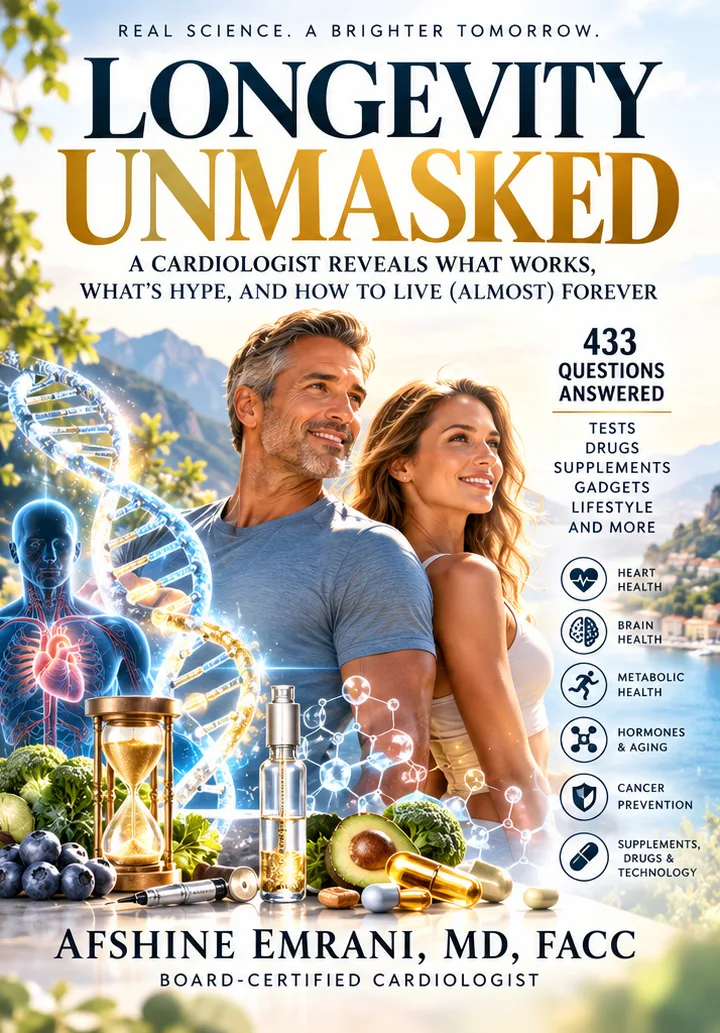
Longevity Unmasked
A Cardiologist Reveals What Works, What’s Hype, and How to Live (Almost) Forever
433 questions answered by cardiologist Afshine Ash Emrani, MD, FACC.
Popular: blood pressure · ApoB · GLP-1 · creatine · sauna · testosterone
Featured topics
Go straight to what concerns you

Heart Health
The Heart of the Matter · Know Your Numbers
30 questions →

Brain Health
Protecting Your Brain · Sleep, Stress, and Mood
25 questions →
Metabolic Health
Metabolism, Insulin Resistance, and the GLP-1 Era · Food, Fasting, and Alcohol
37 questions →

Hormones & Aging
The Truth About Aging · Bones and Joints · Menopause, Hot Flashes, and a Woman’s Second Half · Testosterone and a Man’s Second Half
56 questions →
Cancer Prevention
Cancer: Prevention and Early Detection
16 questions →
Supplements, Drugs & Technology
Supplements, Ranked by Evidence · The Longevity Drugs · Repurposing Today’s Medicines for Longevity · The Toy Chest: Every Drip, Device, and Gadget, Graded · The Med Spa Menu: Skin, Shape, and Sex · Mind, Body, and the Experimental Shelf · The Frontier: Regenerative Medicine
119 questions →

Tests & Numbers
31 questions →

Movement & Foundations
31 questions →

Sleep Apnea
9 questions →

Gut, Inflammation & Immunity
10 questions →

Industry, Clinics & Costs
23 questions →

Purpose, Questions & What’s Next
46 questions →
All 12 topics shown; together they cover all 29 parts and 433 questions. Topic grouping is editorial navigation, not part of the book.
Start here
The one-page plan
If you read nothing else, read this page. It is the whole book in ten steps, in the order I would have you do them.
- 1Measure blood pressure properly at home. Discuss an appropriate target; below 130/80 mm Hg is common when treatment is indicated. Treating hypertension substantially reduces cardiovascular risk. (Part 3)
- 2Review your cardiovascular and metabolic risk. Begin with appropriate lipids and glucose testing; discuss Lp(a) once, and selective ApoB or hs-CRP when the result could change care. (Part 4)
- 3Lift something heavy twice a week, and walk every day. (Part 6)
- 4Allow roughly seven to nine hours for sleep on a regular schedule, and get tested if you snore. (Parts 7 and 8)
- 5Eat real food: half the plate plants, protein at every meal, little sugar, little alcohol. (Part 9)
- 6Do the screening that is proven: colon, breast, cervical, lung if you smoked, bone density, and a heart calcium score at the right age. (Parts 16 and 13)
- 7Treat what you find, early and without apology. Medicines for blood pressure and cholesterol are the real longevity drugs. (Parts 3 and 19)
- 8Stay current on vaccines, hearing, vision, and teeth. (Parts 24 and 12)
- 9Spend nothing on extras until steps 1 through 8 are done. Then use the scorecards. (Parts 20 and 5)
- 10Protect your people and your purpose. They predict your future as well as your cholesterol does. (Part 29)
In 60 seconds
Each part, distilled
Part 1
The Truth About Aging
- Many diseases of later life develop over years; earlier risk reduction can help, but cannot prevent every death.
- Your genes set less of your fate than your habits and your medical care do.
- Five foundations beat every product: no tobacco, controlled blood pressure, muscle, sleep, and people.
Part 3
The Heart of the Matter
- Heart disease is the leading killer and the most preventable.
- Know three numbers: blood pressure, ApoB, and Lp(a).
- A normal stress test does not exclude plaque. A calcium score detects calcified plaque and is useful in selected risk decisions.
Part 6
Muscle and Movement
- Exercise is the most powerful medicine there is.
- Two strength sessions and 150 minutes of easy cardio a week cover most of the benefit.
- Strong legs and practiced balance are what prevent the fall that ends independence.
Part 11
Metabolism, Insulin Resistance, and the GLP-1 Era
- Insulin resistance smolders for a decade before diabetes is diagnosed.
- Waist size, glucose testing, lipids, and the clinical history help identify metabolic risk.
- GLP-1 medicines are a major advance; they require protein and strength training.
Part 17
Supplements, Ranked by Evidence
- No supplement has been shown to extend human life.
- Test, correct what is low, and add only what has human evidence.
- Bring every bottle to your doctor once a year.
Part 20
The Toy Chest: Every Drip, Device, and Gadget, Graded
- Sort every gadget onto three shelves: reasonable, pleasant, or leave it.
- Sauna has the best long-term data of any of these toys.
- IV drips, NAD infusions, cryotherapy, and soft pressure chambers are not worth the money.
Tools from the book
Check yourself, then talk to your doctor
Screening and record-keeping only, never a diagnosis. Everything you enter stays in your browser.
STOP-BANG sleep apnea screening
Eight yes-or-no items from Part 8, Q110.
Metabolic syndrome check
Five measures from Part 11, Q137.
The 13 areas prevention review
A checklist for your next visit, from Part 5, Q65.
Home strength and balance tests
Grip, chair stands, walking speed, one-leg stand (Part 4, Q49).
The book’s five worksheets
My Numbers, screening, my last good decade, purpose, people.
How to read the evidence
Every answer tells you what it rests on
Each numbered answer ends with an evidence scope: what kind of knowledge supports the answer, whom it concerns, and which outcome it addresses. A strong result for one use does not establish a different use. Relief of pain, a lower blood test, fewer heart attacks, and longer life are different outcomes.
ROBUST HUMAN TRIALS means reasonably convincing intervention evidence for the stated population and outcome. It does not mean everyone should take the treatment. LIMITED or SMALL HUMAN STUDIES means the available trials leave important uncertainty.
OBSERVATIONAL means an association was measured without random assignment. A finding can be consistent and important while still being affected by confounding, selection, or reverse causation. A risk marker is not automatically a treatment target.
PRECLINICAL means cells or animals. NOT DEMONSTRATED means that the proposed clinical benefit has not been established; it does not prove that benefit is impossible. A negative trial is described for the population and endpoint it actually tested.
GUIDELINE-BASED, REGULATORY STATUS, and CLINICAL JUDGMENT answer different questions. A recommendation is not a trial result. FDA approval is indication-specific. A spending preference or forecast is not given a clinical efficacy grade.
01
THE EVIDENCE LADDER
HUMAN OUTCOME TRIALS → OBSERVATIONAL DATA → SMALL HUMAN STUDIES → ANIMAL AND CELL STUDIES. Each answers a different question. Strong evidence for one outcome does not prove a different outcome.
02
THE MONEY FILTER
FIRST: blood pressure, smoking, lipids, exercise, sleep, preventive care. NEXT: tests or treatments that change a decision. LAST: expensive devices, infusions, and experimental compounds. Ask: What improves, for whom, and at what risk?
03
THE TEST-TO-ACTION PATH
QUESTION → Is the test validated? → Would the result change care? → Are false positives understood? → Discuss with your clinician → Act and reassess.
04
THE HEALTHSPAN EQUATION
Years alive ≠ years well. Protect physical function, cognition, independence, and relationships. No single biomarker or gadget measures the whole person.
The book at a glance
What the evidence looks like across 433 answers
Evidence grade. 433 questions; a question with mixed evidence counts under each grade.
Figure from the book · Q2
Evidence grade: share of each part’s grade tags. Select a part to open it.
- A Robust human trials
- B Limited or small human studies
- C Observational
- D Preclinical / mechanistic
- E Established clinical knowledge
- G Guideline-based / consensus
- R Regulatory status
- J Clinical judgment / author synthesis
- F Not demonstrated / insufficient
- Pending
I use thirteen areas to organize a prevention conversation. They are not thirteen targets that everyone must measure or drive downward. (Part 5, Q65)
- 1.Blood pressure
- 2.LDL cholesterol and, selectively, ApoB
- 3.Lp(a)
- 4.Glucose regulation
- 5.Triglycerides and HDL
- 6.Waist size
- 7.Kidney function
- 8.Liver health
- 9.Fitness
- 10.Strength and balance
- 11.Bone and fracture risk
- 12.Screening and vaccination status
- 13.Medication and supplement review


Live Longer. Live Wiser.
About the author
Afshine Ash Emrani, MD, FACC, is a board-certified cardiologist and the founder of Los Angeles Heart Specialists in Tarzana, California, which he established in 1999. He is an Assistant Clinical Professor at the UCLA David Geffen School of Medicine, where he has been on the clinical faculty for more than two decades.
Dr. Emrani has held Castle Connolly Top Doctor recognition since 2008 and has been named a Los Angeles Magazine Super Doctor since 2010. He is the author of Beyond the White Coat, A Woman’s Heart, GLP-1 Breakthrough, Echoes, Awaken to Your Soul, and other books, and writes regularly on medicine, meaning, and the inner life in his Substack newsletter.
His work rests on a simple conviction: that the best medicine treats the whole person, body and soul, and that a physician’s first duty is to tell the truth kindly.
A Healthier You. A Brighter Tomorrow.
Voices worth following
Keep learning from evidence-minded creators
On X
- Follow
Eric Topol, MD @EricTopol
Physician-scientist; author of Super Agers; writes Ground Truths.
831K followers
- Follow
Peter Attia, MD @PeterAttiaMD
Physician focused on longevity; author of Outlive (discussed in the book).
664K followers
- Follow
Layne Norton, PhD @BioLayne
Nutritional sciences PhD known for debunking diet and supplement myths.
233K followers
- Follow
Matt Kaeberlein, PhD @mkaeberlein
Biology-of-aging researcher; candid about what is and is not proven.
32K followers
- Follow
Andrew Steele, PhD @statto
Longevity scientist and author of Ageless; science communicator.
13K followers
On Substack
- Read
Your Local Epidemiologist · Katelyn Jetelina, PhD, MPH
Public-health science translated for everyday decisions.
416K+ subscribers
- Our story, told in 20 minutes Oct 23, 2026
- Read
Ground Truths · Eric Topol, MD
Deep dives on new medical research, including aging and prevention.
217K+ subscribers
- Connecting Our Immune System and Healthspan Oct 11, 2026
- Read
Sensible Medicine · Multiple physician authors
Physicians debating the strength of medical evidence. Opinions vary by author.
107K+ subscribers
- Having my say, again, about Grail’s Galleri test Oct 23, 2026
- Read
Inside Medicine · Jeremy Faust, MD
An emergency physician on medical news and what the data actually show.
88K+ subscribers
- Read
Brad Stulberg · Brad Stulberg
Evidence-informed writing on well-being, habits, and sustainable performance.
19K+ subscribers
- 8 All-Timers on Becoming Your Best Oct 20, 2026
Inclusion is not endorsement. These creators are listed for evidence-focused reputation and reach. Their views are their own and may differ from the book. Counts were verified on 2026-10-22; latest Substack posts were fetched when this site was built (Oct 23, 2026).
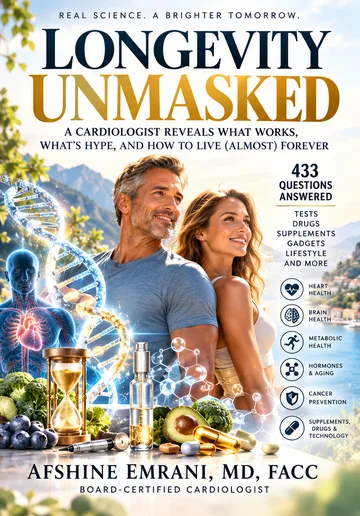
The book
Cut Through the Noise. Get the Facts That Matter.
433 Evidence-Graded Answers About Living Longer and Better. Revised edition, October 2026.